back to HYPP Zoology home page
Insecta, Lepidoptera, Noctuidae .
Description, Biology, Life Cycle, Damage, Common Names, Images
[R]Biology
- Host plants: the larvae first attack the leaves of certain wild plants, then, in cultivated plots, the leaves of red beet, potatoes, cereals, flax, vegetables and even nursery plants.
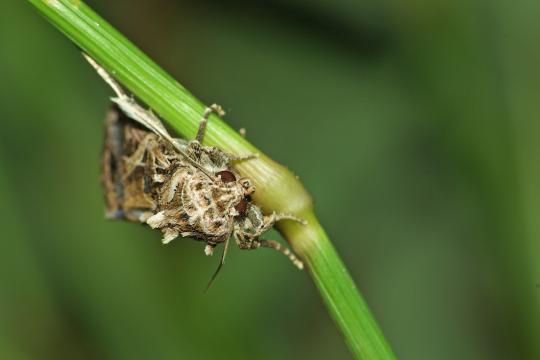
- Adult: the moths, generally nocturnal, fly very rapidly, either alone or in small groups, sometimes in swarms which can be composed of millions of individuals travelling over hundreds of kilometers.
- Larva: the caterpillar is especially active during the night: it nibbles the lamina of leaves and cuts the leaf-stalks (petioles). During the day, it remains pressed against the underside of the leaves. Larval development lasts about a month.
- Pupa: the larva pupates in the folds of the leaves of the host plant (*) and the adults emerge 10 to 15 days later.
[R]Life Cycle
- The importance of the migrations leads to a geographical distribution of the species which differs considerably from season to season, so there is no distinct development cycle in any given place. The common silver y moth is common in North Africa and in the Mediterranean basin during winter; in summer, it occurs as far north as Scotland and Finland.
- The adults fly in the Paris region from the end of May to the beginning of June. A second flight takes place generally at the end of July.
[R]Damage
In years of swarming, colonies of thousands of individuals invade cultivated fields (red beet, potato, etc.). The older caterpillars are particularly voracious (*) . Such invasions enable the development of numerous natural enemies of the caterpillar, particularly certain viral diseases whose effect is such that the second generation is almost non-existant.

HYPPZ on line : Species (scientific name), Pests (common names), Glossary, Crops.
back to HYPP Zoology home page